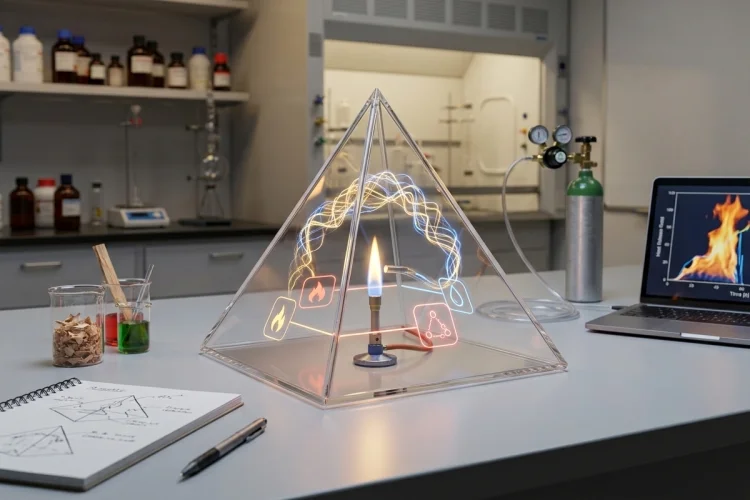
A flame may look simple, but a surprisingly complex chemical process is happening inside it. Fuel is being heated, gases are reacting with oxygen, energy is being released, and new reactions are keeping the flame alive.
Many people learn that fire requires three ingredients: fuel, heat, and oxygen. This model, known as the fire triangle, provides a useful introduction to fire science. However, it does not fully explain how flames continue burning after ignition.
That is where the fire tetrahedron and combustion come in. The tetrahedron adds a fourth requirement: an uninhibited chemical chain reaction. This continuing reaction connects the other three elements and makes sustained flaming combustion possible.
Understanding this model can help explain why different extinguishing agents work, why certain materials burn more easily, and how small ignition sources can become dangerous fires.
In this beginner-friendly guide, we will examine each part of the fire tetrahedron, explore the combustion process, and discuss practical ways to prevent or stop a fire.
What Is the Fire Tetrahedron?
The fire tetrahedron is a four-sided model representing the essential requirements for a sustained fire. Its four elements are fuel, heat, an oxidising agent, and an uninhibited chemical chain reaction.
A tetrahedron is a three-dimensional shape with four triangular faces. It improves on the traditional fire triangle by showing that combustion involves more than simply placing a combustible material near heat and oxygen.
According to the National Institute of Standards and Technology, all four elements must be present for a fire to occur and continue. Controlling or removing even one can interrupt the burning process.
The model is widely used in fire investigation, workplace safety, firefighter education, and combustion science. It provides a straightforward way to understand both fire development and fire suppression.
The First Element: Fuel
Fuel is the material consumed during combustion. Wood, paper, fabric, petrol, cooking oil, natural gas, plastics, and many other substances can act as fuels.
However, solid and liquid materials do not always burn directly. Heat often causes them to release gases or vapours, which mix with an oxidising agent and react in the flame.
A candle is a familiar example. Heat from the flame melts the wax, which travels through the wick and vaporises. The wax vapour then reacts with oxygen and burns.
The condition of a fuel affects how easily it ignites. Thin, dry materials usually heat more quickly than thick or damp ones. Fine combustible particles can be especially dangerous because their large surface area allows them to react rapidly.
For instance, dispersed dust from sugar, flour, wood, coal, plastics, or certain metals can create serious fire and explosion hazards. OSHA notes that particle size, shape, concentration, and moisture content can influence how easily combustible dust ignites.
The Second Element: Heat
Heat provides the energy needed to bring fuel to its ignition temperature. Without enough energy, the material will not begin a self-sustaining combustion process.
Common heat sources include flames, electrical sparks, lightning, hot equipment, friction, welding operations, cigarettes, and chemical reactions. Some sources are obvious, while others may develop unnoticed inside machinery, batteries, wiring, or walls.
Heat also changes the physical and chemical condition of fuel. A solid material may begin breaking down through a process called pyrolysis, releasing flammable gases that can ignite when mixed with oxygen.
Once a fire starts, it generates additional heat. That energy warms nearby fuel, causes more vapours to form, and allows the burning area to grow.
Heat can move by conduction, convection, and radiation. Conduction transfers energy through materials, convection carries it through moving gases or liquids, and radiation sends energy outward as electromagnetic waves.
These mechanisms help explain how fire can spread beyond the object where it began.
The Third Element: An Oxidising Agent
An oxidising agent supports the chemical reaction that allows fuel to burn. In most everyday fires, the main oxidiser is oxygen in the surrounding air.
During combustion, oxygen reacts with fuel molecules. This rapid oxidation process releases heat and usually produces light in the form of a flame or glow.
Although oxygen itself is not normally a fuel, it can make other materials burn more intensely. Oxygen-enriched environments are particularly dangerous because some substances can ignite more easily and burn much faster than they would in ordinary air.
Oxygen is not the only possible oxidiser. Certain chemicals can supply oxygen or otherwise promote combustion. These substances require careful storage because they may cause nearby fuels to burn even without a normal supply of atmospheric oxygen.
Reducing contact between a fuel and its oxidiser can suppress some fires. Covering a small candle with a glass, for example, limits the available oxygen until the flame goes out.
The Fourth Element: The Chemical Chain Reaction
The chemical chain reaction is what separates the fire tetrahedron from the simpler fire triangle. It describes the continuing sequence of reactions that keeps flaming combustion active.
When fuel vapours react with oxygen, highly reactive particles known as free radicals are created. These particles take part in additional reactions, producing more heat and new reactive species.
As long as this chain continues without being sufficiently interrupted, the flame can sustain itself. The released heat produces more combustible vapour, which feeds further reactions.
NIST explains that flaming combustion requires enough reactive molecular species to maintain these chemical chain reactions. Without them, the flame is extinguished even when some heat, fuel, and oxygen remain present.
This fourth element explains why certain extinguishing chemicals can stop a flame without completely removing the fuel or all the surrounding oxygen. They interfere with the chemistry occurring inside the combustion zone.
How Does Combustion Actually Work?
Combustion is a chemical oxidation process that occurs rapidly enough to produce heat and usually light. Fire is a visible result of this energy-releasing, or exothermic, reaction.
The process begins when fuel receives enough heat. It may melt, evaporate, or decompose into combustible gases, depending on the material involved.
These gases mix with oxygen in suitable proportions. When the mixture reaches its ignition temperature, chemical bonds break and new substances form. The reaction releases energy as heat and light.
Not all combustion produces a bright flame. Flaming combustion occurs mainly in the gas phase, while smouldering combustion happens more slowly at the surface of a solid material. A sofa, mattress, or pile of vegetation may smoulder before visible flames appear.
Combustion can also be complete or incomplete. With sufficient oxygen and good mixing, fuel burns more completely. When oxygen is limited, incomplete combustion can produce greater quantities of smoke, soot, and carbon monoxide.
Fire Triangle vs Fire Tetrahedron
The fire triangle consists of fuel, heat, and oxygen. It is useful for explaining what must come together for ignition and for teaching basic fire prevention.
The fire tetrahedron contains the same three components but adds the uninhibited chemical chain reaction. It therefore provides a more complete explanation of sustained flaming combustion.
Neither model should be viewed as incorrect. The triangle is a simple starting point, while the tetrahedron offers additional chemical detail.
For everyday prevention, the triangle may be enough to explain why flammable materials should be kept away from ignition sources. For understanding flame behaviour and chemical extinguishing agents, the tetrahedron is more useful.
The key lesson remains the same: a fire depends on several connected conditions. Breaking one part of the system can prevent combustion from beginning or cause an existing flame to stop.
How Fire Extinguishing Methods Break the Tetrahedron
Different extinguishing methods target different elements of the fire tetrahedron. This is why one extinguishing agent is not suitable for every situation.
1. Removing Heat
Water can cool certain burning materials below the temperature required to sustain combustion. It is commonly effective on ordinary solid fuels such as wood, paper, and some fabrics.
However, water can be extremely dangerous on hot cooking oil, energised electrical equipment, reactive chemicals, or burning metals. The correct method must always match the fuel involved.
2. Removing or Separating Fuel
A fire can stop when its fuel supply is removed. Closing a gas valve, creating a firebreak, or moving unburned combustible material away from a small controlled fire are examples.
Fuel control is also important before an incident occurs. Good housekeeping, safe storage, and regular waste removal reduce the amount of material available to burn.
3. Limiting the Oxidiser
Foam, fire blankets, lids, and some gaseous suppression systems can separate fuel from the surrounding air. This reduces the oxygen reaching the combustion zone.
The method must create an effective barrier. Briefly covering a flame and then exposing it again may allow the fire to restart if the fuel remains hot.
4. Interrupting the Chain Reaction
Some dry chemical and specialised extinguishing agents interfere with the chemical reactions inside the flame. They reduce the concentration of reactive particles needed to sustain burning.
OSHA explains that extinguishers may work by cooling the fuel, removing oxygen, or stopping the chemical reaction. The correct extinguisher must be selected for the relevant class of fire.
Why the Fire Tetrahedron Matters for Prevention
The tetrahedron turns fire prevention into a practical question: how can its four elements be kept apart?
At home, that may mean keeping towels away from cooktops, storing fuels away from heat, replacing damaged electrical cables, and never leaving high-temperature cooking unattended.
In workplaces, prevention may involve controlling hot work, maintaining machinery, managing combustible dust, ventilating flammable vapours, and storing oxidising chemicals separately from fuels.
Some incidents begin without an open flame. The US Fire Administration reports that spontaneous combustion and chemical reactions cause an average of around 1,700 home fires per year in the United States.
Materials capable of self-heating should therefore be handled and stored according to their safety instructions.
Smoke alarms and escape plans remain essential because prevention cannot eliminate every possible ignition scenario. Fire can develop rapidly, and smoke may make escape difficult before flames reach other rooms.
The fire tetrahedron explains sustained combustion through four connected elements: fuel, heat, an oxidising agent, and an uninhibited chemical chain reaction.
Fuel provides material to burn, heat initiates and supports the process, oxygen usually acts as the oxidiser, and continuing chemical reactions keep the flame alive.
Removing or controlling any one of these components can prevent a fire or stop it from continuing. However, the safest extinguishing method depends on the type of fuel and the surrounding conditions.
Use this model to review the fire hazards around your home or workplace. Separate combustible materials from heat, maintain electrical equipment, store chemicals correctly, and make sure working smoke alarms and a clear escape plan are already in place.