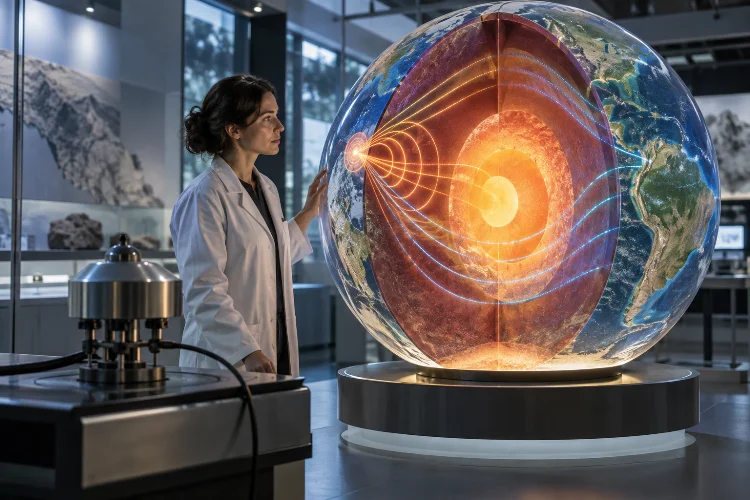
When an earthquake happens, the ground does not simply shake in one place.
Energy released underground spreads outward in the form of waves, traveling through rock, around the planet, and eventually reaching seismic instruments hundreds or even thousands of kilometers away.
These vibrations are called seismic waves.
Understanding How Seismic Waves Travel Through the Earth helps explain much more than why the ground moves during an earthquake.
The speed, direction, and behavior of these waves give scientists valuable information about where an earthquake occurred and what exists deep beneath Earth’s surface.
Some seismic waves move through solid rock and liquid material. Others can only pass through solids, while another group travels mainly along Earth’s surface.
These differences have allowed scientists to investigate parts of the planet humans could never physically reach.
So how does earthquake energy actually travell through an entire planet? It starts with the sudden release of energy along a fault.
What Are Seismic Waves?
Seismic waves are vibrations that carry energy through Earth after a sudden disturbance.
Earthquakes are the most familiar source, but seismic waves can also be produced by volcanic activity, explosions, landslides, and even some human activities.
During an earthquake, accumulated stress can cause rocks to suddenly move along a fault. The released energy radiates outward in multiple directions rather than staying at the point where the rupture begins.
EarthScope explains that this release creates seismic waves that travel through Earth’s interior and across its surface.
Scientists generally divide earthquake waves into two major categories: body waves and surface waves.
Body waves travel through Earth’s interior. These include P waves and S waves.
Surface waves travel mainly along or near the outer surface of the planet. They usually arrive later but can produce some of the strongest shaking experienced during large earthquakes.
How P Waves Travel Through the Earth
P waves, or Primary waves, are normally the first seismic signals to reach a monitoring station after an earthquake.
They are called primary because they travel faster than other major types of earthquake waves.
P waves are compressional waves. The particles in the material move backward and forward in roughly the same direction that the wave itself is moving.
A simple comparison is a Slinky. Push and pull one end of it, and you can watch areas of compression move along the spring. P waves behave in a similar way inside Earth.
One important characteristic makes them extremely useful to scientists: P waves can travel through solids, liquids, and gases.
Near Earth’s surface, their speed through solid rock can be around 6 kilometers per second, although the exact velocity varies depending on the material they travel through.
Because they are fastest, P waves usually produce the first noticeable signal on a seismogram.
How S Waves Move Differently
S waves, or Secondary waves, arrive after P waves because they travel more slowly.
Their movement is also very diferent.
Instead of compressing material parallel to the direction of travel, S waves move particles perpendicular to the direction the wave is moving. You can imagine shaking one end of a rope up and down while the wave itself moves horizontally toward the other end.
This side-to-side or up-and-down movement is known as shear motion.
S waves have another crucial characteristic: they cannot travel through liquids.
That difference turned out to be extremely important for understanding Earth’s interior.
When scientists observed that S waves produced by distant earthquakes disappeared beyond certain regions of the planet, it provided strong evidence that Earth’s outer core is liquid.
In typical rock near the surface, S waves may travel at roughly 4 kilometers per second compared with around 6 kilometers per second for P waves.
The increasing time gap between P- and S-wave arrivals is also useful for estimating how far an earthquake occurred from a seismic station.
What Are Surface Waves?
Not all earthquake energy travels deep through the planet.
Some energy moves mainly along Earth’s surface in the form of surface waves.
There are two important types: Love waves and Rayleigh waves.
1. Love Waves
Love waves move the ground horizontally from side to side.
This sideways movement can be especially challenging for buildings because structures often have to resist strong horizontal forces during an earthquake.
2. Rayleigh Waves
Rayleigh waves create a rolling motion that includes both vertical and horizontal movement.
Their movement is sometimes compared with ocean waves because the ground can appear to rise, fall, and roll as the wave passes.
Surface waves generally travel more slowly than P and S waves, so they often arrive last at distant seismic stations. However, they can have large amplitudes and are responsible for much of the damaging shaking associated with strong earthquakes.
This is why the first small vibration felt during an earthquake is not necessarily the strongest shaking that will follow.
Why Seismic Waves Change Speed and Direction
Seismic waves do not travel at exactly the same speed everywhere inside Earth.
Their velocity depends on the physical properties of the material they encounter, including density, rigidity, temperature, and whether the material is solid or liquid.
Earth is made of several major layers, including the crust, mantle, outer core, and inner core. Each layer has different physical characteristics.
When a seismic wave enters material where its speed changes, its path may also bend. This process is called refraction.
Think about light passing from air into water. A straw placed in a glass can appear bent because light changes direction when it passes between materials.
Seismic refracion follows a related principle.
Wave paths inside Earth therefore tend to curve rather than traveling as simple straight lines.
Some waves can also reflect from boundaries between major layers. Scientists study these reflected and refracted signals to understand features such as the boundary between the mantle and the core.
EarthScope’s seismic-wave models show several wave paths involving reflections and passages through different internal layers.
What Is the Seismic Shadow Zone?
One of the most fascinating consequences of seismic-wave behavior is the shadow zone.
Imagine a large earthquake occurring on one side of Earth. Seismic monitoring stations around the planet detect its waves, but certain areas receive no direct P waves.
According to the U.S. Geological Survey, the P-wave shadow zone generally occurs at angular distances of roughly 104 to 140 degrees from an earthquake.
Why does this happen?
P waves entering Earth’s liquid outer core change speed and bend significantly. The resulting refraction redirects them away from this region.
S waves behave differently. Because they cannot travel through liquids, they are stopped at the outer core rather than passing directly through it.
These patterns gave scientists an extraordinary clue about Earth’s structure.
We cannot drill anywhere close to the core, yet earthquake waves effectively act like a medical scan of the planet.
How Scientists Use Seismic Waves to See Inside Earth
Seismologists record ground vibrations using instruments called seismometers.
A sensitive seismomter can detect extremely small movements that people would never notice themselves.
When an earthquake happens, stations around the world record the arrival times and characteristics of different waves. Researchers can compare those signals to determine where the earthquake originated.
The difference between P- and S-wave arrival times is particularly useful.
The farther a station is from an earthquake, the larger the time difference between the arrival of the faster P wave and slower S wave tends to become. Comparing information from several stations allows scientists to locate an earthquake much more accurately.
Scientists can also investigate Earth’s interior using a technique called seismic tomography.
The principle is similar to medical imaging. Instead of using X-rays to look through the human body, researchers analyze seismic waves that have traveled along many different paths through Earth.
If waves move faster or slower than expected in particular regions, scientists can infer differences in temperature, composition, or physical properties.
Seismic tomography has helped researchers study structures in the mantle, subduction zones, fault systems, magma-related features, and boundaries deep inside the planet.
Why Seismic Waves Matter for Earthquake Safety
Learning about seismic waves is not only important for understanding Earth science.
It also has practical value for earthquake monitoring and safety.
Because P waves travel faster than the more damaging waves that follow, earthquake early-warning systems may detect P waves and send alerts before stronger shaking reaches locations farther away.
The warning period may only be seconds in some situations, but even a short amount of time can be valuable.
People may have time to take protective action, trains can slow down, industrial equipment can enter safer operating modes, and some automated systems can respond before stronger shaking arrives.
Networks of seismometers, GPS instruments, and other monitoring technologies are therefore important tools for understanding seismic hazards and improving preparedness.
Seismic waves are not just evidence that an earthquake has happened. They are also information carriers that help us understand both the event and the planet beneath us.
Understanding How Seismic Waves Travel Through the Earth gives us a clearer picture of what happens after energy is suddenly released during an earthquake.
P waves move fastest and can pass through solids and liquids. S waves travel more slowly and only move through solids, while Love and Rayleigh waves spread along Earth’s surface and can produce powerful ground motion.
As these waves pass through different materials, they change speed, bend, reflect, and sometimes disappear. Scientists use those patterns to locate earthquakes, study seismic hazards, and reveal the structure of Earth’s crust, mantle, and core.
The next time you hear about an earthquake, remember that the shaking is also carrying information. Learning how those waves behave is one of the best ways to understand both earthquakes and the hidden world beneath our feet.