When people talk about disasters, workplace accidents, cybersecurity incidents, or environmental hazards, they often focus on one obvious question: “What could go wrong?” But understanding risk requires more than identifying a dangerous event.
A flood, earthquake, chemical leak, or system failure does not automatically create the same level of damage everywhere. The outcome depends heavily on what is located in the affected area, how susceptible those people or assets are, and what happens if the event actually occurs.
That is where Exposure, Vulnerability, and Consequence Explained becomes useful.
These three concepts help us move beyond simply identifying hazards and start understanding how serious a particular risk might become. They are widely used in disaster risk reduction, safety management, engineering, climate adaptation, and many other areas.
The terminology can sound technical at first, but the basic ideas are surprisingly practical. Once you understand the differences, it becomes much easier to analyze risks in everyday situations.
What Is Exposure in Risk Assessment?
Exposure describes the people, buildings, infrastructure, businesses, ecosystems, or other assets located where a hazard could affect them.
The United Nations Office for Disaster Risk Reduction defines exposure as the situation of people and tangible assets located in hazard-prone areas.
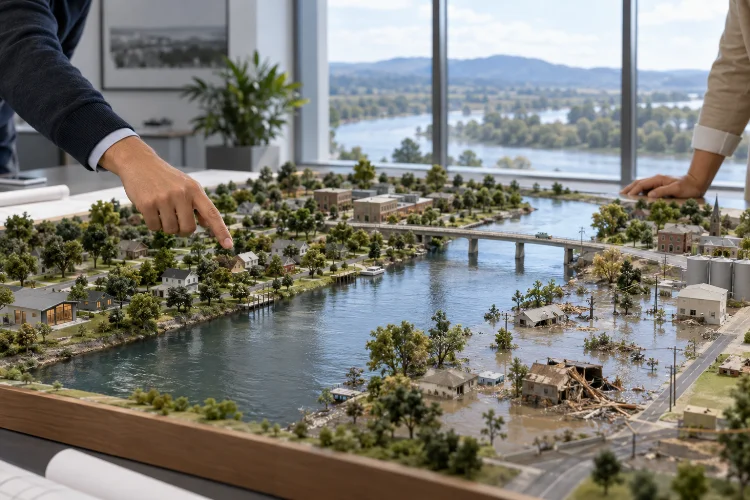
Imagine a river that regularly floods during extreme rainfall. The flood itself represents the hazard. Houses, schools, vehicles, farms, and people located within the floodplain represent the exposure.
If the same flood occurs in an uninhabited area with no valuable infrastructure, the physical hazard may still be powerful, but the potential human and economic losses can be much smaller.
Exposure therefore answers a simple question:
What is in harm’s way?
Exposure can also change over time. A coastal area may have relatively low exposure today, but construction of thousands of homes, hotels, roads, and businesses could dramatically increase future risk without changing the underlying hazard at all.
This is one reason rapid urban development can create new disaster-risk challenges.
What Does Vulnerability Mean?
Exposure tells us what can be affected. Vulnerability tells us how easily those exposed elements may be harmed.
UNDRR describes vulnerability as physical, social, economic, and environmental conditions that increase susceptibility to hazard impacts.
Consider two houses standing beside each other in an earthquake-prone city. Both have almost identical exposure because they are located in the same place.
However, one building follows modern seismic construction standards while the other is an old, poorly maintained structure made from weak materials.
Their exposure may be similar, but their vulnerability is very different.
Vulnerability is not limited to physical buildings either. It can include poverty, limited access to transportation, poor healthcare, weak emergency communication, environmental degradation, or limited financial resources.
A commmunity with strong emergency services and resilient infrastructure may recover faster than another community experiencing the same event but lacking those resources.
In other words, vulnerability asks:
How badly could the exposed people or assets be affected?
What Is Consequence?
Consequence refers to the result or effect that follows if an unwanted event actually happens.
NIST describes a consequence broadly as an effect associated with an event, condition, or system. An adverse consequence is an undesirable outcome associated with loss.
Consequences can take many forms.
A major flood, for example, might cause deaths and injuries, destroy homes, interrupt electricity, close roads, contaminate drinking water, stop businesses from operating, damage crops, and force families to relocate.
Some consequences are immediately visible. Others develop slowly.
A factory fire might cause direct property damage within hours, while lost production, supply-chain disruptions, unemployment, environmental cleanup, and reputation damage could continue for months.
This is why risk assesment should rarely focus only on the first obvious outcome.
Consequence essentially asks:
If the event happens, what could the result be?
Exposure vs. Vulnerability vs. Consequence
These concepts are connected, but they are not interchangeable.
Suppose a powerful cyclone approaches a coastal city.
The homes, residents, hospitals, roads, electricity networks, and businesses located in the cyclone’s path represent exposure.
Weak buildings, poor drainage systems, limited evacuation options, fragile electricity infrastructure, and households without emergency savings contribute to vulnerability.
Deaths, injuries, damaged buildings, power outages, economic losses, displacement, and disrupted public services are potential consequences.
The distinction matters because each factor may require a different solution.
Reducing exposure could mean preventing construction in especially dangerous areas. Reducing vulnerability might involve strengthening buildings or improving evacuation systems.
Reducing consequences could involve emergency plans, backup power, insurance, business continuity measures, and faster disaster response.
Together, these approaches produce much stronger risk management than simply trying to prevent the hazard itself.
How These Factors Work Together to Shape Risk
Risk usually emerges from several interacting factors rather than one isolated problem.
UNDRR describes disaster risk as potential losses determined by the relationship between hazards, exposure, vulnerability, and capacity. The World Bank similarly explains disaster risk through interconnected components including hazard, exposure, and vulnerability.
A simplified way to think about it is:
Hazard + Exposure + Vulnerability → Potential Consequences
This is not a universal mathematical formula, but it is useful for understanding the relationship.
Imagine a strong earthquake occurring beneath an empty desert. The hazard may be severe, but human exposure is extremely low.
Now imagine the same earthquake beneath a densely populated city.
Exposure becomes much higher.
If that city’s buildings are poorly constructed, vulnerability also rises. The possible consequences can then include widespread structural collapse, casualties, infrastructure failures, and major economic disruption.
The hazard has not necessarily become stronger. What changed was the context surrounding it.
A Practical Example: Flood Risk in Two Neighborhoods
Consider two neighborhoods located near the same river.
Neighborhood A contains 2,000 residents, several schools, shops, and hundreds of homes. Neighborhood B contains only agricultural fields and a few storage buildings.
Neighborhood A clearly has greater exposure because more people and valuable assets are located within the hazard area.
Now suppose Neighborhood A has elevated houses, effective drainage, flood warnings, evacuation routes, and residents who regularly participate in preparedness programs.
Neighborhood B’s storage buildings, meanwhile, sit directly at ground level and contain expensive machinery with no flood protection.
The first neighborhood has greater human exposure, but some aspects of its vulnerability may be lower because protective measures already exist.
The example shows why simply counting assets is not enough. A good risk analysis needs to consider where assets are located, how susceptible they are, and the scale of losses that could follow.
FEMA similarly treats hazard, vulnerability, exposure, and risk as separate but closely related concepts within risk assessment.
How to Assess Exposure, Vulnerability, and Consequences
A practical assessment usually begins by clearly identifying the hazard.
You might be examining earthquakes, floods, wildfires, industrial accidents, cyberattacks, extreme heat, or equipment failure.
Next, identify the exposed elements. This may include people, buildings, infrastructure, equipment, financial assets, environmental resources, or critical services.
Then evaluate vulnerability.
Ask whether buildings are strong enough, whether residents can evacuate, whether important equipment has backup systems, whether critical services depend on a single supplier, and whether emergency resources are available.
Finally, consider realistic consequences.
Instead of stopping at “property damage,” think more broadly about casualties, financial loss, environmental effects, service disruption, recovery time, supply chains, social impacts, and secondary failures.
UNDRR notes that disaster-risk assessment involves identifying hazards and examining existing exposure and vulnerability that could harm people, property, services, livelihoods, and the environment.
The goal is not to predict every detail perfectly. It is to identify the most relevent pathways through which a dangerous situation could become a serious loss.
Why Understanding These Concepts Matters
Separating exposure, vulnerability, and consequence makes risk reduction much more practical.
Organizations cannot always eliminate hazards. Cities cannot stop earthquakes from occurring, businesses cannot completely eliminate extreme weather, and factories cannot guarantee that every piece of equipment will operate forever.
But they can often change exposure and vulnerability.
A business can relocate critical equipment away from flood-prone areas. A city can strengthen building codes. Hospitals can install backup generators. Families can prepare evacuation plans and emergency supplies.
Reducing even one part of the risk equation can make the eventual consequences less severe.
This is also why resilience matters. UNDRR describes resilience as the ability of communities or systems exposed to hazards to resist, adapt, and recover while maintaining or restoring essential functions.
Understanding risk is therefore not only about asking what might happen. It is about discovering where intervention can actually make a difference.
Exposure, vulnerability, and consequence provide three different perspectives on the same risk problem.
Exposure identifies who or what is in harm’s way. Vulnerability explains how susceptible those people or assets are to damage. Consequence describes what could happen if the hazardous event actually occurs.
Looking at all three gives a much clearer picture than simply identifying hazards.
Whether you are assessing natural disasters, workplace safety, infrastructure, business continuity, or another type of risk, start by separating these factors.
Identify what is exposed, examine why it might be vulnerable, and think carefully about both immediate and long-term consequences.
The better you understand those connections, the easier it becomes to choose practical actions that reduce risk before an emergency occurs.