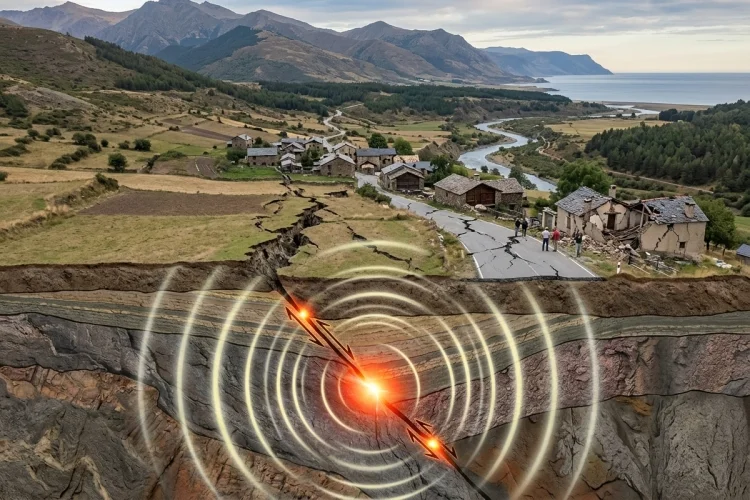
The ground feels solid, but it is never completely still. Far below our feet, enormous sections of Earth’s outer shell are slowly moving, pushing, pulling, and sliding against one another.
Most of this movement is too gradual to notice. Occasionally, pressure that has accumulated for years is released in seconds, producing an earthquake.
Understanding how earthquakes happen does not require an advanced geology degree. The process is fairly simple: tectonic forces place stress on rocks, friction keeps them locked together, and the rocks eventually break or slip along a fault.
That sudden movement releases energy, which travels outward as seismic waves and makes the ground shake. The effects depend on more than magnitude.
Depth, distance, local soil, fault movement, and building quality all influence what people experience. This beginner’s guide follows the process from moving tectonic plates to aftershocks and tsunamis.
What Is an Earthquake?
An earthquake is ground shaking caused by a sudden release of energy inside Earth. Most natural earthquakes begin when blocks of rock rapidly slip past each other along a fault.
A fault is a fracture, or zone of fractures, between blocks of rock. Movement may happen slowly as creep, but a sudden slip releases seismic energy into the surrounding crust.
Earthquakes occur constantly, although most are too small or remote to be felt. The USGS National Earthquake Information Center locates about 20,000 events worldwide each year, or roughly 55 per day, while many smaller ones remain undetected.
How Tectonic Plates Create Earthquakes
Earth’s rigid outer layer, the lithosphere, is divided into tectonic plates. These plates move slowly over hotter, weaker material below them, often at rates comparable to fingernail growth.
Their boundaries may pull apart, collide, or slide sideways. Rough rock surfaces create friction, so parts of a boundary can remain locked while the surrounding plates keep moving.
Stress then builds in the nearby rock, rather like bending a wooden ruler. Once the stress becomes stronger than the friction holding the fault in place, the rocks suddenly slip and release their stored energy.
Most earthquakes happen near plate boundaries, although stress can also reactivate old faults within a plate.
Where Does an Earthquake Begin?
The underground point where the rupture starts is called the hypocentre, or focus. The epicentre is the point on Earth’s surface directly above it.
News reports usually mention the epicentre because it is easy to place on a map. Scientists also examine focal depth because it affects how strongly the event is felt at the surface.
A shallow earthquake often produces stronger local shaking than an equally sized deep one because its energy travels a shorter distance. Earthquakes can occur down to roughly 800 kilometres, although most happen at depths of less than 80 kilometres.
How Seismic Waves Shake the Ground
When a fault slips, energy spreads outward as seismic waves. These waves travel through Earth and along its surface, moving rocks, soil, buildings, and other structures.
1. P Waves
P waves, or primary waves, arrive first because they travel fastest. They compress and expand material in their direction of movement, much like repeatedly pushing and pulling a spring.
These waves usually produce the first, lighter movement detected by a seismometer. They can travel through both solid and liquid materials.
2. S Waves
S waves, or secondary waves, arrive after P waves. They move the ground from side to side or vertically and often produce stronger shaking.
Unlike P waves, S waves cannot travel through liquid. This characteristic has also helped scientists study the internal structure of Earth.
3. Surface Waves
Surface waves travel near Earth’s exterior. They may create rolling or horizontal movements that are particularly damaging to buildings and infrastructure.
Seismometers record these different waves, allowing scientists to calculate an earthquake’s time, location, and magnitude. The gap between P- and S-wave arrivals also helps estimate the distance between a recording station and the earthquake source.
Where Are Earthquakes Most Common?
Earthquakes occur at all three main types of tectonic plate boundary. However, the style, location, and possible depth of the earthquakes vary between them.
At divergent boundaries, plates move apart. These earthquakes are commonly shallow and often happen along mid-ocean ridges, where new oceanic crust is created.
At transform boundaries, plates slide horizontally past each other. California’s San Andreas Fault is a well-known example of this type of tectonic setting.
At convergent boundaries, plates move toward each other. In some locations, one plate descends beneath another through a process called subduction.
Subduction zones can produce earthquakes at shallow, intermediate, and deep levels. The largest recorded earthquakes generally occur on enormous subduction-zone faults known as megathrusts.
This pattern explains the frequent seismic activity around the Pacific Ring of Fire, including Indonesia, Japan, Chile, and Alaska. These regions lie near active boundaries where major tectonic plates interact.
Magnitude, Intensity, and Earthquake Damage
Magnitude measures an earthquake’s overall size and the energy released at its source. Scientists commonly use the moment magnitude scale, particularly when measuring large events.
The magnitude scale is logarithmic rather than linear. Each increase of one whole magnitude represents approximately 32 times more energy.
That means a magnitude 7 earthquake releases around 32 times as much energy as a magnitude 6. A magnitude 8 releases roughly 1,000 times more energy than a magnitude 6.
Intensity is different. It describes the strength of shaking and its effects at a specific location.
One earthquake has one calculated magnitude, but it can produce several intensity levels. Someone near the source may experience violent movement, while a person hundreds of kilometres away may notice only gentle shaking.
Local geology also plays an important role. Soft soil and loose sediment may amplify ground motion, while the design, materials, and condition of buildings influence how much damage occurs.
Why Aftershocks Happen
The largest earthquake in a sequence is called the mainshock. Smaller events that follow in the same general area are known as aftershocks.
A mainshock changes the distribution of stress around the fault. Nearby sections of rock then adjust to those new conditions, producing additional earthquakes.
Aftershocks usually become less frequent over time, but they may continue for months or even years. They remain dangerous because buildings, bridges, roads, and slopes may already have been weakened by the original event.
An earthquake that occurs before a larger event may later be called a foreshock. However, scientists cannot identify it as a foreshock until the larger earthquake has happened.
How Undersea Earthquakes Can Cause Tsunamis
Some undersea earthquakes generate tsunamis, but not every offshore earthquake does. A tsunami requires a large and sudden displacement of seawater.
The greatest concern usually comes from powerful, shallow earthquakes that move the ocean floor vertically. This movement pushes a large volume of water and creates a series of long waves that travel away from the source.
Most earthquake-generated tsunamis are associated with events above magnitude 7.0. However, magnitude alone does not determine whether one will form. The earthquake’s depth, fault type, location, and amount of seafloor movement also matter.
In deep water, tsunami waves may be relatively low and difficult to notice. As they enter shallower coastal water, they slow down, grow taller, and can produce destructive flooding and powerful currents.
Can Scientists Predict Earthquakes?
Scientists can map active faults, monitor seismic activity, study previous events, and calculate the probability of future earthquakes in a particular region.
However, no reliable method can currently predict the exact time, location, and magnitude of a major earthquake in advance. Claims based on unusual clouds, animal behaviour, physical symptoms, or vague dates are not scientifically dependable.
Earthquake early-warning systems are not prediction systems. They detect an earthquake that has already started and send information faster than damaging seismic waves can travel.
Depending on a person’s distance from the source, this may provide several seconds to take protective action.
Because exact prediction remains unavailable, preparation is essential. People in earthquake-prone areas should follow local guidance, secure heavy furniture, strengthen vulnerable buildings, and practise “Drop, Cover, and Hold On.”
Earthquakes happen when tectonic movement builds stress in rocks until a fault suddenly slips. The rupture starts at the hypocentre, and released energy travels outward as seismic waves that shake the ground.
Most earthquakes occur near plate boundaries, although old faults within plates may also become active.
Magnitude measures an event’s size, while local intensity depends on depth, distance, geology, and construction quality. Mainshocks may be followed by aftershocks, and some large undersea events can generate tsunamis.
We cannot stop earthquakes or predict their exact arrival, but preparation can reduce harm. Check the earthquake guidance for your area, secure hazards at home, and create a simple emergency plan before the next tremor occurs.