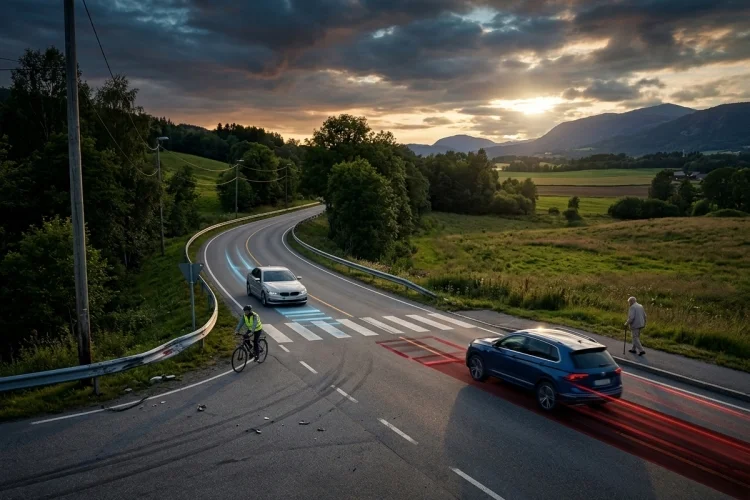
Driving only a little faster may not feel especially dangerous. The road looks clear, the vehicle feels stable, and modern brakes can create a sense that stopping will always be easy.
However, even a modest increase in speed can significantly change the outcome when something unexpected happens. Understanding how speed affects crash severity begins with two simple facts.
A faster vehicle travels farther before the driver can react, and it carries more energy into a collision. This combination makes crashes both harder to avoid and more damaging when they occur. The relationship is not linear.
Doubling speed does not merely double the destructive energy involved-it produces roughly four times as much kinetic energy. Pedestrians, cyclists, motorcyclists, children, and older adults are particularly vulnerable because they have little or no protection from the impact.
This guide explains how speed changes stopping distance, collision forces, vehicle control, and injury risk. It also shows why choosing a safe speed matters even when a driver is travelling within the legal limit.
Why Speed Makes Crashes More Likely
Higher speed gives drivers less time to notice and respond to danger. A pedestrian may step into the road, traffic may stop suddenly, or debris may appear just beyond a bend.
At 30 km/h, a vehicle travels about 8.3 metres every second. At 60 km/h, it travels roughly 16.7 metres during the same period. Before the driver has even started braking, the faster vehicle has already covered twice the distance.
Speed can also reduce the amount of visual information a driver processes. The faster the vehicle moves, the more quickly road signs, junctions, pedestrians, and changing traffic conditions arrive.
It may become harder to steer safely around an obstacle or recover after a mistake. NHTSA identifies greater loss-of-control potential, longer stopping distance, and more severe injuries as key consequences of speeding.
How Speed Changes Stopping Distance
Stopping distance has two main parts: reaction distance and braking distance.
1. Reaction Distance
Reaction distance is how far the vehicle travels between the moment a driver detects danger and the moment braking begins. It is affected by speed, attention, fatigue, alcohol, medication, visibility, and the complexity of the situation.
If speed doubles while reaction time stays the same, reaction distance also doubles. A distracted or tired driver may travel even farther because it takes longer to recognise the problem.
This is why looking at a phone for only a few seconds can be so dangerous. At higher speeds, those seconds represent a substantial distance travelled without full attention.
2. Braking Distance
Braking distance begins when the brakes take effect and ends when the vehicle stops. Under similar conditions, it generally rises approximately with the square of speed.
In simplified terms, doubling speed can require around four times the braking distance. Real results also depend on tyres, brakes, road gradient, vehicle weight, surface grip, and weather.
Wet roads, loose gravel, ice, worn tyres, and poor vehicle maintenance can extend the distance further. Higher speed leaves less room for any of these conditions to be handled safely.
Why Impact Energy Rises So Quickly
A moving vehicle carries kinetic energy. The basic formula is:
Kinetic energy = ½ × mass × speed²
The important part is that speed is squared. This means a small increase in velocity creates a much larger increase in the energy that must be absorbed during a collision.
If the speed of the same vehicle doubles, its kinetic energy becomes four times greater. If speed triples, the energy becomes nine times greater.
During a crash, this energy must go somewhere. It may deform the vehicle, damage roadside objects, throw occupants forward, or transfer into the body of a pedestrian or cyclist.
Seat belts, airbags, crumple zones, helmets, and road barriers can help manage impact energy, but they cannot remove it. As collision speed rises, these protective systems face increasingly severe forces.
Speed and the Severity of Occupant Injuries
Inside a moving vehicle, occupants are travelling at approximately the same speed as the car. When the car hits something and stops suddenly, their bodies continue moving until restrained by a seat belt, airbag, interior surface, or another object.
Greater impact speed produces stronger deceleration forces. These forces can injure the brain, chest, spine, abdomen, and internal organs even when the passenger compartment remains largely intact.
Modern vehicles are designed to absorb energy through controlled deformation. Seat belts spread forces across stronger parts of the body, while airbags reduce contact with hard interior surfaces.
However, occupant-protection systems have physical limits. NHTSA notes that speeding can reduce the effectiveness of vehicle safety equipment and increase the severity of injuries when a collision happens.
Crash direction also matters. Side impacts provide less space between an occupant and the striking vehicle than frontal impacts. WHO reports that the fatality risk for vehicle occupants in a car-to-car side impact can reach 85% at an impact speed of 65 km/h.
Why Pedestrians and Cyclists Face Greater Risk
Pedestrians and cyclists do not have seat belts, airbags, metal frames, or crumple zones surrounding them. Their bodies absorb a large share of the impact directly.
A pedestrian collision may involve several stages. The vehicle first strikes the person, who may then hit the bonnet, windscreen, road surface, or another object.
The faster the vehicle is moving, the stronger these impacts become. A higher approach speed also makes it less likely that the driver can stop before reaching the pedestrian.
According to WHO, the risk of pedestrian death rises rapidly with impact speed. The risk increases approximately 4.5 times when the striking speed rises from 50 km/h to 65 km/h.
Children may be especially difficult to see because of their height, while older adults can be more vulnerable to severe injury.
Lower speeds are therefore critical near schools, homes, shopping areas, crossings, and other places where motor vehicles mix with people walking or cycling.
Small Changes in Average Speed Have Large Effects
Drivers sometimes assume that travelling a few kilometres per hour faster makes little difference. Across an entire road network, however, small changes in average speed can produce major changes in crash outcomes.
WHO reports that every 1% increase in mean speed is associated with approximately a 3% increase in serious-crash risk and a 4% increase in fatal-crash risk.
The International Transport Forum reports a similar relationship: a 1% increase in average speed is associated with roughly 2% more injury crashes, 3% more fatal and serious crashes, and 4% more fatal crashes.
This relationship also works in the safer direction. Modest reductions in average speeds can prevent some collisions entirely and reduce the force involved in crashes that still happen.
A driver who reduces speed before a busy junction may stop in time to avoid a collision. Even when complete avoidance is impossible, the lower impact speed may turn a fatal crash into a survivable one.
Legal Speed Is Not Always Safe Speed
A posted speed limit is the maximum speed permitted under normal legal conditions. It is not a guarantee that travelling at that number is safe in every situation.
Drivers should reduce speed when visibility, road grip, traffic, weather, or surrounding activity makes the limit unsuitable. Heavy rain, fog, darkness, roadworks, sharp bends, parked vehicles, and crowds of pedestrians may all require a lower speed.
The same principle applies when approaching schools, crossings, residential streets, and areas with cyclists or motorcyclists. A driver should be able to stop within the distance that can be seen to be clear.
Speed choice should also leave room for other people’s mistakes. Someone may misjudge a gap, run a red light, open a car door, or step into the road without looking.
Defensive driving means choosing a speed that provides enough time and space to manage these predictable errors rather than depending on a perfect response from everyone else.
How Speed Limits Reduce Crash Harm
Effective speed limits are based on road function, traffic mix, roadside development, and the vulnerability of people who use the area.
Motorways designed to separate opposing traffic and remove pedestrians can safely accommodate higher speeds than busy urban streets. Where vehicles regularly mix with pedestrians and cyclists, lower speeds reduce both collision probability and injury severity.
The Safe System approach accepts that people will make mistakes. Roads, vehicles, and speed limits should therefore be designed so those mistakes do not routinely lead to death or life-changing injury.
WHO describes speed management as a central part of road safety because travel speed influences crash risk, injury severity, and the chance of death.
Useful measures may include credible speed limits, traffic-calming features, safer street design, enforcement, public education, and vehicle technologies such as intelligent speed assistance.
Practical Ways Drivers Can Manage Speed
Good speed management begins before a hazard becomes urgent. Scan the road ahead, watch for brake lights, and identify places where people or vehicles could enter your path.
Maintain a generous following distance. This improves visibility and creates extra space for smooth braking when traffic changes.
Slow down before bends, junctions, crossings, and poor road surfaces rather than braking harshly after entering them. Adjust speed early when rain, glare, darkness, or fog reduces visibility.
Avoid treating the speed limit as a target. Choose a speed that matches the real conditions, and allow additional travel time so that delays do not create pressure to rush.
Finally, keep tyres, brakes, lights, and windscreens in good condition. Vehicle maintenance cannot cancel the laws of physics, but it helps the vehicle use the available stopping distance effectively.
Speed affects crash severity in several connected ways. It increases the distance travelled before braking, lengthens the braking distance, reduces the time available to respond, and dramatically raises the energy released during impact.
Because kinetic energy increases with the square of speed, even a modest increase can produce much stronger collision forces. Pedestrians, cyclists, and motorcyclists face particularly high risks because they lack the protection available inside a vehicle.
The most effective action is simple: choose a speed that suits the road, visibility, weather, and people around you-not merely the posted maximum. On your next journey, leave a larger gap, scan farther ahead, and reduce speed early whenever conditions become uncertain.