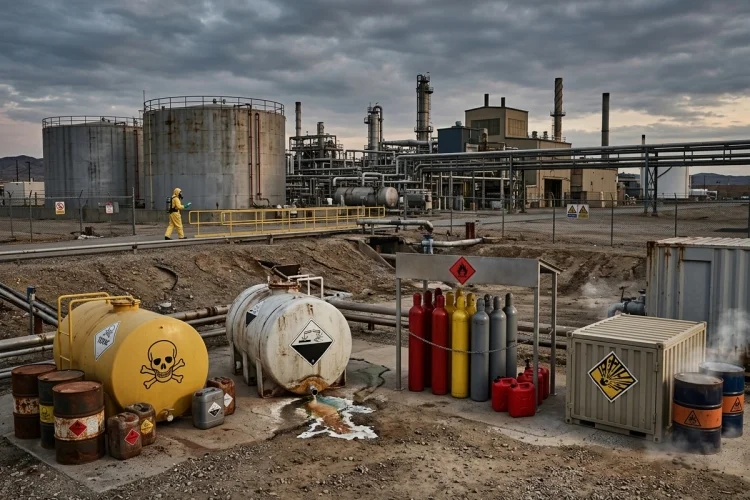
A bottle of drain cleaner, a can of paint thinner, and a cylinder of compressed gas may all carry hazard symbols. However, they are not dangerous in the same way.
One might damage body tissue, another could ignite, and another may react violently when mixed with the wrong substance.
Understanding toxic, corrosive, flammable, and reactive chemicals helps you recognise what can go wrong and choose the right precautions. These categories describe different hazardous properties, although one product can belong to more than one category.
For example, a solvent may be both toxic and flammable. A strong acid may be corrosive, toxic when inhaled, and reactive with certain metals. The label therefore needs to be read as a complete safety message rather than as a single symbol.
This beginner-friendly guide explains the four chemical hazard types in plain English. It also covers exposure routes, hazard labels, Safety Data Sheets, storage compatibility, and practical ways to reduce chemical risks at home and in the workplace.
Why Chemical Hazard Categories Matter
Chemical classification is a scientific process used to determine the kinds of harm a substance or mixture can cause. Hazards may involve human health, physical events such as fire or explosion, or damage to the environment.
Knowing the category helps people decide how a chemical should be labelled, stored, transported, handled, and disposed of. It also influences the type of ventilation, emergency equipment, training, and personal protective equipment that may be required.
However, hazard and risk are not identical. A hazard is the potential to cause harm, while risk depends on the likelihood and severity of that harm under real conditions.
A sealed bottle of flammable liquid remains hazardous, but its risk may be relatively low inside an approved cabinet away from heat. The risk becomes much higher when the same bottle is left open beside an ignition source.
What Is a Toxic Chemical?
A toxic chemical can harm the body when it is inhaled, swallowed, absorbed through the skin, or introduced through another exposure route. The effects depend on the substance, dose, concentration, exposure duration, and individual susceptibility.
Some toxic effects appear quickly. A high exposure may cause headache, dizziness, nausea, breathing difficulty, unconsciousness, or organ damage.
Other effects develop after repeated or long-term contact. Certain substances may affect the nervous system, lungs, blood, liver, kidneys, reproductive system, or other organs.
Chemical health hazards can also include carcinogenicity, sensitisation, irritation, and damage to specific target organs.
Toxicity is not always easy to recognise. A harmful gas may be colourless, and smell is not a dependable exposure detector. Some people may stop noticing an odour after being around it for a while.
Common toxic hazards can include certain pesticides, solvents, heavy metals, industrial gases, and fumes generated during work. Even a product that is safe during ordinary use may become dangerous when heated, sprayed, mixed, or used without ventilation.
What Is a Corrosive Chemical?
A corrosive chemical can destroy or permanently damage materials through chemical action. When discussing health hazards, corrosion commonly refers to serious damage to skin or eyes.
Strong acids and bases are familiar examples, but corrosiveness cannot be judged simply by whether something is called an acid or alkali. Concentration, temperature, contact time, and chemical composition all affect the severity.
Contact with a corrosive substance may cause severe burns, permanent eye injury, or damage to the respiratory tract if corrosive mist or vapour is inhaled.
Under GHS-style classification, products capable of severe skin burns and eye damage use the corrosion pictogram and strong hazard wording.
Some chemicals are also classified as corrosive to metals. This is a physical hazard rather than a direct description of skin injury, although the same substance may have both properties.
Corrosive products should be stored in compatible containers. A substance that attacks metal, plastic, or another container material can create leaks even when the original container appeared secure.
What Is a Flammable Chemical?
A flammable chemical can ignite relatively easily when its vapour, gas, aerosol, solid, or dust meets a suitable ignition source. Flames, sparks, hot surfaces, static electricity, and overheated equipment can all provide ignition energy.
Flammable liquids are particularly deceptive because the liquid itself is not usually what burns above the container. Vapour released from the liquid mixes with air and ignites when the concentration and temperature are suitable.
Examples may include petrol, alcohol-based products, paint thinners, adhesives, and many solvents. Cyclohexane, for instance, is identified by NIOSH as a flammable liquid with inhalation and contact exposure routes.
Good ventilation can help prevent vapour accumulation, but it does not make unsafe handling acceptable. Containers should remain closed when not in use, and flammable products must be kept away from heat, flames, smoking, and equipment that may spark.
Combustible dust also deserves attention. Fine particles dispersed in air can burn rapidly or explode under certain conditions, even when the original solid material seems difficult to ignite. Relevant materials can include wood, flour, sugar, coal, plastic, and some metals.
What Is a Reactive Chemical?
A reactive chemical can undergo a dangerous chemical change when exposed to heat, pressure, impact, air, water, or an incompatible substance. The reaction may release large amounts of heat, pressure, flammable gas, or toxic and corrosive products.
The word “reactive” covers several behaviours. Some substances are thermally unstable, some react vigorously with water, and others may ignite spontaneously when exposed to air.
Water-reactive chemicals can become especially dangerous when standard firefighting assumptions are applied. OSHA describes this class as chemicals that may become spontaneously flammable or release dangerous quantities of flammable gas after contact with water.
Reactive chemicals are not the same as flammable chemicals, although a reaction may produce fire. They are also not identical to oxidisers, but oxidising substances can intensify combustion and react dangerously with fuels or organic materials.
A common cause of chemical incidents is mixing incompatible products. Even two substances that are individually familiar may create heat, pressure, toxic gas, or splashing when combined.
Can One Chemical Fit Several Categories?
Yes. Chemical hazard categories frequently overlap because they describe different properties rather than completely separate groups.
A substance may be toxic when inhaled, corrosive to skin, and reactive with water. Another may be flammable and harmful after repeated exposure.
Nitric acid demonstrates this overlap. NIOSH describes it as corrosive to metals and notes that, although it is not combustible itself, it can increase the flammability of combustible materials.
Ammonia provides another example. Its solution can affect the skin and eyes, it is incompatible with several chemical groups, and it can corrode certain metals.
This overlap is why you should never identify a chemical’s safety requirements from only one word, pictogram, or general product category. Read the full label and review the Safety Data Sheet before using an unfamiliar product.
How Labels Communicate Chemical Hazards
Modern chemical labels may use elements based on the Globally Harmonized System of Classification and Labelling of Chemicals, commonly called GHS.
The system supports more consistent communication of health and physical hazards through pictograms, signal words, hazard statements, and precautionary statements.
The skull-and-crossbones pictogram can indicate serious acute toxicity. The corrosion symbol can warn of severe skin or eye damage and corrosion to metals, while the flame pictogram identifies several fire-related hazards.
An exploding-bomb symbol may appear for certain explosive or highly reactive hazards. However, not every reactive chemical uses the same pictogram because classification depends on its specific behaviour and severity.
The signal word Danger is generally reserved for more severe categories, while Warning is used for less severe ones. Neither word should be read without the accompanying hazard and precautionary statements.
Labels provide an immediate summary, but they cannot include every technical detail. That information is found in the product’s Safety Data Sheet.
How to Use a Safety Data Sheet
A Safety Data Sheet, or SDS, is a structured document describing a chemical’s properties, hazards, handling precautions, emergency measures, and exposure controls.
The standard format contains 16 sections. Important sections cover hazard identification, ingredients, first aid, firefighting, spill response, handling and storage, exposure controls, stability and reactivity, and toxicological information.
For toxic chemicals, check exposure routes, symptoms, occupational limits, and recommended controls. For corrosive products, look for compatible materials, emergency washing instructions, and required eye or skin protection.
For flammable products, review flash-related information, suitable extinguishing media, ventilation needs, and ignition-control measures. For reactive substances, examine the stability and reactivity section carefully, especially incompatible materials and conditions to avoid.
The SDS should be read before an incident, not while someone is already dealing with a leak, fire, or exposure.
How Should These Chemicals Be Stored?
Safe storage begins with compatibility, not simply available shelf space. Chemicals that may react with one another should be separated according to the label, SDS, and local regulations.
Flammable liquids may require an approved storage cabinet away from ignition sources. Corrosive substances may need resistant trays or cabinets that can contain leaks without being damaged.
Reactive chemicals may require controlled temperatures, dry conditions, protection from impact, or isolation from air and water. Toxic chemicals need secure storage that prevents accidental access and limits releases.
Keep products in their original labelled containers unless a proper workplace procedure allows transfer into another compatible, correctly labelled container. Never use drinks bottles or food containers for chemical storage.
Incompatible storage, flammable materials near ignition sources, and unsuitable shelving are recognised chemical risk factors.
How to Control Chemical Risks
The strongest approach is to remove the hazardous chemical when possible. If elimination is not practical, consider replacing it with a safer product or using a less hazardous process.
Engineering controls, such as enclosed systems and local exhaust ventilation, help reduce exposure at its source. Administrative controls include training, written procedures, restricted access, inspection, and good housekeeping.
Personal protective equipment may include chemical-resistant gloves, goggles, face shields, protective clothing, or respiratory protection. PPE must be selected for the specific chemical because one glove or respirator type does not protect against every substance.
Never rely on appearance, smell, or past experience alone. Review the label and SDS, use the chemical only as intended, and make sure emergency equipment is suitable for the hazard.
During an unknown spill or reaction, move away, warn others, and contact trained emergency personnel. Do not attempt to smell, touch, dilute, neutralise, or clean an unidentified chemical.
Toxic, corrosive, flammable, and reactive chemicals create different kinds of danger. Toxic substances harm the body, corrosives destroy tissue or materials, flammables ignite easily, and reactive chemicals may change violently under certain conditions.
These categories can overlap, so a single product may require several precautions. Labels offer a quick warning, while Safety Data Sheets explain exposure risks, incompatibilities, storage requirements, and emergency actions in greater detail.
Review the chemical products in your home or workplace today. Confirm that every container is labelled, separate incompatible substances, remove unnecessary ignition sources, and make sure users know where to find the SDS before handling begins.