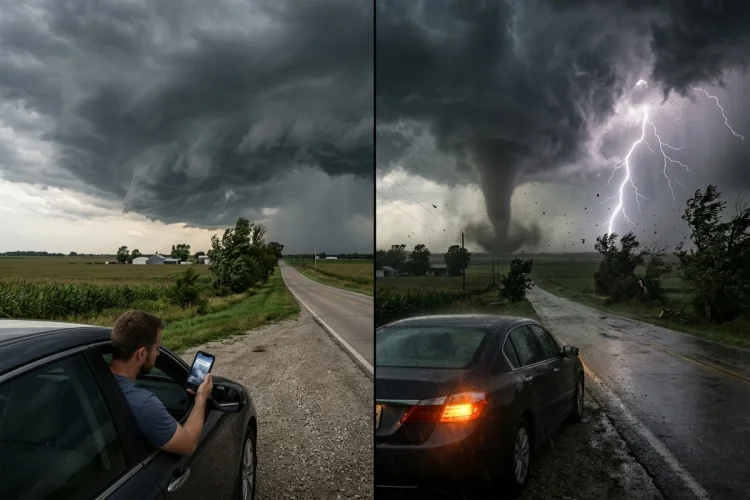
Your phone suddenly displays a severe weather alert. It says a thunderstorm watch has been issued, but a few hours later, another notification announces a thunderstorm warning. The words sound similar, yet they call for very different responses.
Understanding weather watches vs warnings can help you decide whether to review your plans or take immediate protective action.
In general, a watch means hazardous weather is possible because atmospheric conditions are favourable. A warning means dangerous weather is happening, approaching, or highly likely within a specific area.
However, watches and warnings are not limited to thunderstorms. Weather agencies may issue them for tornadoes, floods, winter storms, hurricanes, extreme heat, strong winds, coastal flooding, and other hazards.
This guide focuses mainly on terminology used by the US National Weather Service. Other countries may use different names, colours, or alert levels, so you should always check guidance from your local weather authority.
Once you understand the basic watch-versus-warning principle, weather alerts become much easier to interpret.
What Is a Weather Watch?
A weather watch means that the risk of a hazardous weather event has increased, but its exact timing, location, or occurrence remains uncertain. The ingredients for dangerous conditions may be present, even though the event has not necessarily developed yet.
Think of a watch as a message to prepare and pay attention. It gives people time to review safety plans, adjust travel arrangements, secure outdoor objects, charge communication devices, and monitor updated forecasts.
A watch can cover a fairly large area because forecasters are identifying a region where storms or other hazardous conditions could develop. Not every town inside the watch area will necessarily experience severe weather.
For some hazards, watches may be issued many hours before the expected event. The exact lead time varies according to the type of weather, forecast confidence, and local criteria.
What Is a Weather Warning?
A weather warning is more urgent. It means that a hazardous weather or hydrological event is occurring, imminent, or highly likely, and may threaten life or property. People inside the warning area should take the recommended protective action without unnecessary delay.
Warnings are usually more specific than watches. They may cover a city, part of a county, a group of communities, or a narrow path expected to be affected by a storm.
A warning may be based on radar data, observations from trained weather spotters, reports from emergency services, or strong forecast evidence. For example, a tornado warning may be issued when radar indicates tornado-producing rotation or when a tornado has been observed.
The correct response depends on the hazard. A tornado warning may require moving immediately to an interior room on the lowest level of a strong building. A flash flood warning may require avoiding low-lying areas and never driving through floodwater.
Weather Watches vs Warnings: The Main Difference
The easiest way to remember the distinction is:
Watch means prepare. Warning means take action.
A watch tells you that dangerous weather is possible. A warning tells you that the threat is occurring, approaching, or expected soon.
You can also compare the terms to making food. A watch means all the ingredients are available in the kitchen. A warning means the meal has already been prepared and is being served.
The analogy is not perfect, but it highlights the difference between favourable conditions and an active threat. A watch should not be ignored simply because the weather currently looks calm. Storms can form quickly once the right atmospheric ingredients come together.
Similarly, receiving a warning does not mean every home inside the alert area will definitely be damaged. It means the danger is serious enough that people should protect themselves rather than wait to see what happens.
Tornado Watch vs Tornado Warning
A tornado watch means severe thunderstorms capable of producing tornadoes are possible in or near the designated area. During a watch, people should review where they would shelter and remain ready to act quickly.
A tornado warning means a tornado is imminent, occurring, or indicated by reliable evidence such as weather radar. When a warning is issued for your location, move to safe shelter immediately.
The safest available location is generally a basement, storm shelter, or small interior room on the lowest floor of a sturdy building. Stay away from windows and protect your head and neck from flying debris.
Do not wait until you see a funnel cloud. Heavy rain, darkness, hills, trees, or buildings may hide an approaching tornado. In some cases, a tornado warning can also be issued without a tornado watch already being active.
Severe Thunderstorm Watch vs Warning
A severe thunderstorm watch means storms capable of producing damaging wind or large hail are possible across the watch area. It does not guarantee that a severe storm will reach every community.
Under National Weather Service criteria, a severe thunderstorm can produce wind gusts of at least 58 mph, hail at least one inch in diameter, or both. These storms may also generate frequent lightning, intense rain, and occasionally tornadoes.
A severe thunderstorm warning is issued when severe conditions are occurring or expected soon within a more specific area. The warning usually identifies the storm’s location, direction of movement, communities in its path, and the main hazards.
During a warning, move indoors and stay away from windows. Avoid using electrical equipment connected to wall outlets, and delay outdoor activities until the threat has passed.
A storm does not need to produce a tornado to become dangerous. Straight-line winds can damage roofs, uproot trees, interrupt electricity, and turn unsecured outdoor objects into flying debris.
What About Advisories and Outlooks?
Watches and warnings are only part of the weather-alert system. You may also see terms such as outlook and advisory.
An outlook highlights the possibility of significant weather several days in advance. Forecast confidence may still be limited, but the outlook allows people to recognise that a potentially disruptive period is approaching.
An advisory generally covers hazardous conditions that are less serious than warning-level events. The conditions may still cause significant inconvenience and could become dangerous when people fail to use caution.
For example, a winter weather advisory may be issued when snow or ice is expected to make travel difficult but is not forecast to reach the local threshold for a winter storm warning.
Thresholds can vary by region. An amount of snow that causes major disruption in a warm climate may be routine in an area with extensive snow-removal equipment. This is why alerts should be interpreted using local information rather than one universal set of numbers.
Can a Warning Be Issued Without a Watch?
Yes. A warning does not always need to be preceded by a watch.
Weather may develop more rapidly or differently than forecast, leaving little time for an earlier watch. A local storm can also become severe even when the wider atmospheric environment did not justify placing a large region under a watch.
For severe thunderstorms, National Weather Service guidance confirms that warnings can be issued without a severe thunderstorm watch already being in effect.
This is one reason people should keep emergency alerts enabled even when no watch has been announced. It is also important to use more than one source of warnings, especially during overnight storms or power disruptions.
Useful options may include official mobile alerts, local weather applications, radio, television, emergency-management messages, and weather radio. Avoid relying only on social media, where information may be delayed, incomplete, or taken from an outdated forecast.
What Should You Do During a Watch?
A watch is the time to make practical preparations rather than panic. Check the expected timing of the hazard and determine whether your home, workplace, school, or travel route lies inside the watch area.
Review your safest shelter location and make sure everyone in your household understands how to reach it. Bring loose outdoor items inside, charge phones, locate flashlights, and check essential supplies.
People planning outdoor events should identify nearby shelter and consider whether plans need to change. Travellers should review road conditions and avoid routes that may become vulnerable to flooding, snow, ice, or strong winds.
Continue monitoring official forecasts because a watch may be updated, expanded, cancelled, or upgraded to a warning as new information becomes available.
What Should You Do During a Warning?
When a warning includes your location, stop monitoring casually and begin following the recommended safety instructions.
Read the complete alert rather than only its headline. It should identify the affected area, expected timing, primary hazards, and appropriate action.
Do not assume you are safe because the weather outside still looks normal. Radar can detect threats before they are visible from your home, and dangerous conditions may arrive within minutes.
You should also avoid travelling to observe storms, floods, large waves, or tornadoes. This can place you in danger and interfere with emergency responders.
Remain in a safe location until officials indicate that the immediate threat has passed. Remember that one warning can be followed by another, especially when several storms move through the same region.
Common Mistakes People Make
One common mistake is treating a watch as unimportant. A watch is not a guarantee of severe weather, but it is an early opportunity to prepare before conditions become urgent.
Another mistake is waiting for visual confirmation after receiving a warning. Dangerous wind, flooding, or tornadoes may be difficult to see, particularly at night.
People may also assume that alerts apply to an entire state or province equally. In reality, warning boundaries can be highly specific, so check your exact location.
Finally, avoid relying on outdoor warning sirens as your only alert method. Sirens may not be designed to be heard inside every building, and their purpose varies between communities.
The difference between weather watches and warnings comes down to possibility and urgency. A watch means hazardous weather could develop, so you should prepare, review your plans, and monitor updates.
A warning means the danger is occurring or approaching, so immediate protective action may be necessary. Watches usually cover larger areas and involve greater uncertainty.
Warnings are generally more localised and communicate a more immediate threat. Advisories describe lower-level but potentially disruptive conditions, while outlooks provide earlier notice of possible hazards.
Check which agency issues official alerts in your area, enable emergency notifications, and make sure your household understands where to shelter. Knowing the terminology before severe weather arrives can save valuable time when every minute matters.